Achieving Success in Math for All Students
Authored by Dr. Debbie Monson
Teaching mathematics involves the development of students’ conceptual and procedural understanding. Teachers focus on academic standards while implementing pedagogy that gives all students an opportunity to learn. These pedagogical choices are imperative for creating an equitable classroom where all students are given opportunities to explore mathematical ideas, communicate with one another, and develop as mathematical thinkers. To create this type of learning environment, teachers can use multiple representations along with strategies for leading group discussions.
Multiple representations provide students an opportunity to learn by offering different ways to see, think about, and explain problems. The translation model (NCTM, 2014) proposes that students learn by moving between using pictures, concrete models, written and verbal communication, as well as symbols when learning mathematical ideas. Teachers can use this model to help create and examine their lessons by considering the opportunities their students have to translate among these representations. Given these multiple representations, students find ways to make connections and share those ideas with one another while the teacher facilitates that conversation.
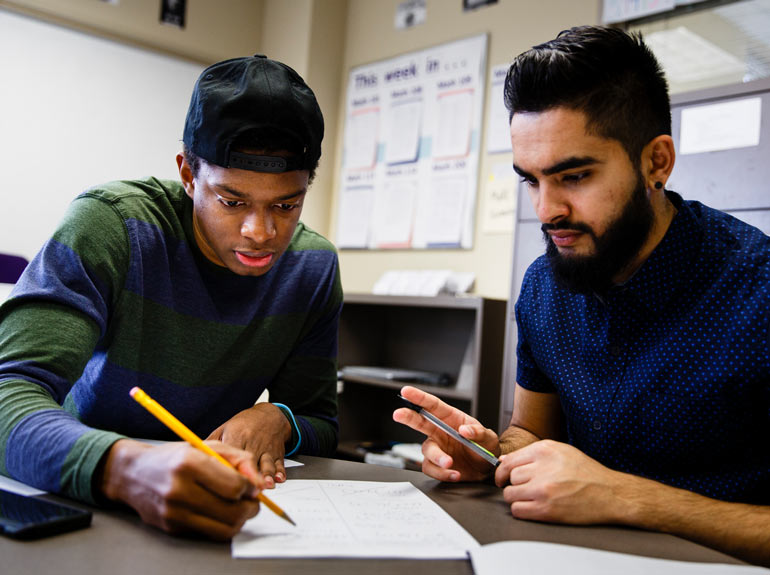
However, sharing ideas in mathematics is more than just having students raise their hand and give the correct answer. Effective discussion involves providing “opportunities for students to make sense of complex ideas together and support one another to speak and listen in ways that advance the classroom community and common good” (Teaching Works). The "5 Practices for Orchestrating Productive Mathematics Discussion" (Smith & Stein, 2011) provides an overall framework for creating discussions in the mathematics classroom. But knowing the steps to leading a discussion is not enough. Teachers need to be aware that discussion can either disrupt or support patterns of inequity. By pushing all students to think, giving adequate time for thoughtful discussion, supporting and listening to a variety of students’ ideas, as well as accepting and fostering creative thinking teachers can disrupt patterns of inequity.
Teaching with discussion and multiple representations can sometimes take longer than a quick lesson where the teacher shows a solution strategy, and the students follow it. However, the payoff is in the long run, because all students are given the opportunity to learn and are treated as important to the whole class thinking. One fear teachers have is that students will not generate the ideas needed to construct a robust discussion. If this happens, the teacher may need to ask additional questions or help students break the problem down to get them to a point they can begin. As teachers use discussion more frequently, students gain confidence, can better communicate about mathematics, and ideally learn perseverance in solving problems as they know they can rely on their own knowledge or that of their peers. It is a culture that is important to making mathematics accessible to all students.
An easy way to start building discussion in the classroom is implementing Number Talks or Math Talks. These talks can be used to build number sense and then extended to build discussion on other problems.
Some resources that may help improve your ability to facilitate discussion or implement number talks are:
- Number Talks: extract from online course (youcubed.org)
- Smith, M. S., & Stein, M. K. (2011). 5 practices for orchestrating productive mathematics discussions. Reston, VA: National Council of Teachers of Mathematics.
- Parrish, Sherry. (2010). Number talks: helping children build mental math and computation strategies, grades K-5. Sausalito, CA: Math Solutions.
- Leading a discussion (TeachingWorks Resource Library)
Bibliography
NCTM (2014). Principles to Actions: Ensuring Mathematical Success for All. NCTM: Reston, VA. Children’s Mathematics.
Smith, M.S. & Stein, M.K. (2011). 5 Practices for Orchestrating Productive Mathematics Discussions. NCTM: Reston, VA.